


You are using an unsupported browser that may limit access to certain website applications. If you continue, you may not be able to access certain pages or process requests. Please use one of our recommended browsers to experience the website properly.
Stay the Course or Sell Out
Missing just a few of the market’s strongest days could have a lasting impact on your savings
October 28, 2026
Imagine checking your portfolio during a market downturn and hitting “sell.” Now imagine the market rebounds the very next day — one of its strongest of the year — and you’re no longer in it. You didn’t just avoid a bad day. You missed a great one. And that single decision could cost you far more than the downturn ever did.
When the market gets rocky, the urge to act is powerful. Moving your money out can feel like the safest, most rational thing to do. But there’s a catch many investors overlook: Getting out is only half the decision. You also have to know exactly when to get back in — and that’s where even the most seasoned investors can stumble.
Some of the market’s strongest days happen when uncertainty is at its highest and investors feel the least confident. If you’re sitting on the sidelines during those key moments, the impact on your long-term savings can be significant.
A few days can make a big difference
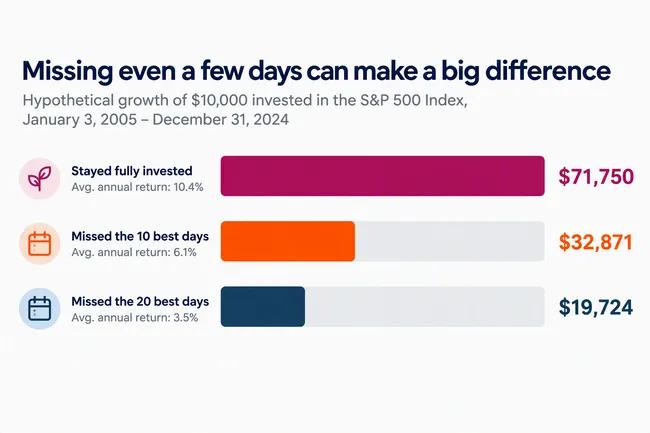
Consider this example. If you had invested $10,000 in the S&P 500 Index on January 3, 2005, and stayed invested through December 31, 2024, your investment would have grown to approximately $71,750.
But what if you missed just the market’s 10 best days during that time? Your ending value drops to about $32,871 — less than half. Miss the 20 best days, and it falls to roughly $19,724.
That’s the power of a handful of days over two decades. Long-term investing isn’t just about avoiding the bad days. It’s about making sure you’re there for the good ones.
Why timing the market is so hard
Many people assume they can ride out downturns on the sidelines and step back in once things improve. The problem? Market recoveries often happen quickly, and some of the biggest gains occur when investors are still feeling nervous.
Successfully timing the market means getting two decisions right: 1)When to get out and 2) When to get back in. Getting one right is tough. Getting both right is even tougher.
What you can do during uncertain markets
Instead of focusing on headlines or daily market swings, consider focusing on the things you can control.
- Revisit your plan. Your financial plan was built around your goals, timeline and comfort with risk. Before making major changes, take a step back and ask whether those goals have actually changed. If they haven’t, your plan may still be working exactly as intended.
- Stay diversified.* A diversified mix of investments can help reduce reliance on any one area of the market and may help smooth out the ride during periods of volatility. Keep in mind that diversification does not guarantee a profit or protect against loss.
- Get guidance when you need it. If market volatility has you questioning your next move, a financial professional can help you evaluate your options and stay focused on your long-term strategy.
No one knows exactly what the market will do next. But history has shown that trying to jump in and out can be costly. Missing even a handful of the market’s strongest days can have a meaningful impact on long-term results. Staying invested, sticking to your plan and avoiding emotional decisions can help keep you moving toward your long-term goals.
Image transcript: Missing even a few days can make a big difference
Hypothetical growth of $10,000 invested in the S&P 500 Index from January 3, 2005 through December 31, 2024: Stayed fully invested: $71,750 ending value; 10.4% average annual return
Missed the 10 best days: $32,871 ending value; 6.1% average annual return
Missed the 20 best days: $19,724 ending value; 3.5% average annual return
The graphic shows that missing just a small number of the market’s best-performing days can substantially reduce long-term investment growth.
Related Items



*While using diversification and/or asset allocation as part of your investment strategy neither assures nor guarantees better performance and cannot protect against loss in declining markets, they are well recognized risk management strategies.
This material is provided by Voya for general and educational purposes only; it is not intended to provide legal, tax or investment advice. All investments are subject to risk. Please consult an independent tax, legal or financial professional for specific advice about your individual situation.
CN6029381_1028