How visual imagery transforms benefits decision-making in the workplace
New research from the Voya Behavioral Finance Institute for Innovation
August 25, 2025
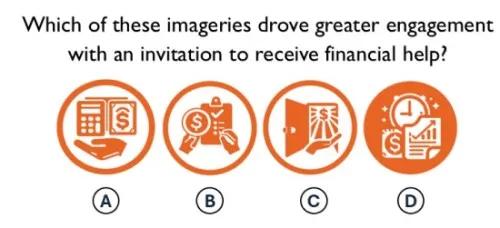
To begin, review the poll question below and mentally select an answer from A to D. We will explore this question throughout the article.
Key takeaways from the research
- Break through decision paralysis: Many employees feel overwhelmed when selecting their benefits. Visual imagery can help simplify these complex choices at a glance.
- Understand the key barriers to action that prevent employees from engaging with their benefits: People have different barriers to action and will respond to different types of imagery. Tailoring imagery to match behavioral tendencies and known barriers can help improve engagement and lead to smarter financial decisions.
- Bridge the gap: A potential disconnect between employees’ needs and the strategies designed to support them highlights an opportunity for benefits leaders to apply behavioral insights. By understanding what truly drives action, we can reshape engagement efforts to eliminate barriers and promote better financial and benefits decisions.
How visual imagery transforms benefits decision-making in the workplace
Ensuring that employees stay informed about their benefits beyond initial or open enrollment is a year-round priority. Many organizations recognize that employees often forget about valuable programs, like their retirement plan, financial planning tools or wellness initiatives, unless they receive regular reminders. Inaction often arises from psychological, environmental or motivational barriers that make decision-making feel difficult. In the case of retirement plan enrollment, many employees postpone signing up or adjusting their contributions — not due to a lack of interest but because the process feels too complex, uncertain or daunting. Removing these obstacles can make taking action easier and more intuitive.
Retirement plans often include numerous options, investment choices and complex percentages. Faced with too many decisions, people may disengage entirely. Without financial expertise, many employees worry about picking the wrong investment strategy or not saving enough, leading them to delay action. There can also be a fear of making the wrong decision and shame around asking for help. Some individuals hesitate to commit to a contribution level, worrying about locking themselves into an amount they may later regret. Sometimes, lack of expertise is not the problem; instead, believing that one already knows more about money or investing than they actually do is the problem, leading to suboptimal decisions.
By integrating intuitive imagery that directly addresses these obstacles — like icons that guide users toward key actions, that demystify financial steps or that perhaps encourage reflection — plan sponsors and benefits leaders can boost adoption of employer benefits. Framing guidance with symbolic visuals can help make decision-making more accessible, leading to greater engagement and better financial decisions.
What did we test?
In recent research conducted by the Voya Behavioral Finance Institute for Innovation, we examined whether imagery addressing barriers to financial help-seeking would influence decisions to adopt financial guidance and optimize investment allocations.
- First, experimental imagery was created to address specific barriers related to financial literacy, overconfidence, embarrassment, the motivation to save time and social norms.

- We tested the imagery in an online experiment designed to simulate employees’ digital experience of investment selection during retirement plan enrollment. The imagery appeared alongside the question, "Would you like to receive some guidance while making these choices?"
What we tested with employees
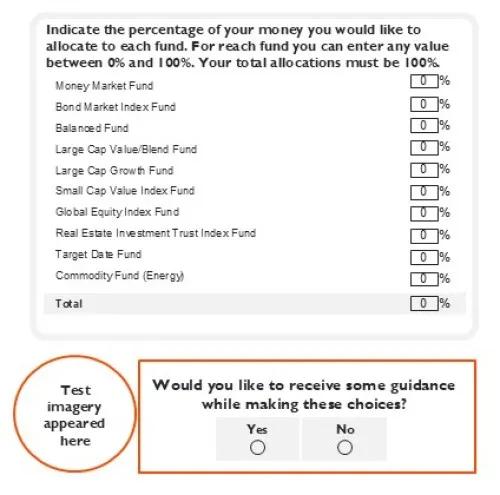
- Next, we asked over 150 benefits leaders, plan sponsors, advisors and third-party administrators to identify which of the imageries from the aforementioned study they thought would drive greater engagement with an invitation to receive help with one’s investments.
What we tested with plan sponsors and financial professionals
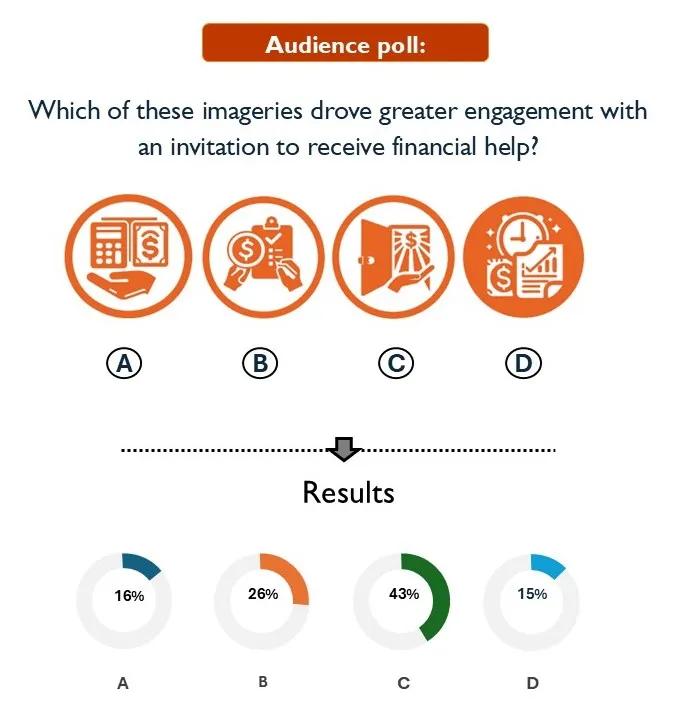
Results showed that the majority (43%) of respondents selected an icon designed to address embarrassment, while only 26% selected an icon designed to address overconfidence — which was the more common barrier to action.
Overconfidence bias is common and can lead investors to overestimate their knowledge and abilities, resulting in higher costs, lower returns and poor choices. Identifying and responding to this bias can promote more optimal decisions about retirement plans, health care coverage and other workplace benefits.
The discrepancy between what drove positive action and what benefits leaders believed would drive action possibly reveals a critical gap between participants’ needs and the strategies designed to support them. If benefits leaders underestimate or misidentify the psychological, environmental or motivational barriers that prevent action, their interventions may fail to effectively drive engagement. This disconnect can lead to lower adoption rates, participant frustration and missed opportunities for financial security. Addressing this gap requires leaders to incorporate behavioral insights, user-centered design and clear communication strategies — ensuring that retirement benefits are not only accessible but truly actionable for participants.
Written by Christelle Ngnoumen, Ph.D.
Dr. Ngnoumen is AVP, Behavioral Finance Research, at Voya Financial, where she leads behavioral science research and experimentation to help people boost their savings and benefits utilization.
Voya data from a live polling of benefits leaders, May 29, 2025 (153 respondents)
Any financial services firm that adopts this strategy will need to ensure they are complying with regulatory requirements as well as firm policies around communications with the public and the use of AI.
FINRA has routinely commented on problematic images in communications with the public that could be considered promissory or misleading. Any images created using this strategy must be reviewed and receive approval prior to use.
This information is provided by Voya for your education only. Neither Voya nor its representatives offer tax or legal advice. Please consult your tax or legal advisor before making a tax-related investment/insurance decision.
Products and services offered through the Voya® family of companies.
CN4678550_0827