


You are using an unsupported browser that may limit access to certain website applications. If you continue, you may not be able to access certain pages or process requests. Please use one of our recommended browsers to experience the website properly.
Turn your tax refund or bonus into future income
Give yourself a boost
March 16, 2026
You’ve heard it all before: Save more for retirement, skip the latte, start a side hustle — and if you get a tax refund or bonus, save that too.
Some of these ideas may work for you, and some may not. But if you are receiving a tax refund, or any unexpected “found money” like a bonus, consider this: Putting a portion toward retirement savings can help you build momentum. It’s a small move today that can help support your future goals.
Let’s reframe your extra funds
It’s your money. And while it can be tempting to spend it all, you can also choose to put part of it to work for you.
Meet Alex.
This year, Alex got a $2,400 tax refund.
With so many competing financial priorities, it was tempting to use it elsewhere: catch up on bills, book a quick getaway, or replace a laptop that had been limping along for years.
He chose a simple approach. He set some of the refund aside for breathing room and used the rest to free up $35 a week in his budget. No major changes, just fewer takeout nights, one unused subscription and a slightly smaller online cart.
He made a choice for the future: an automatic $35 weekly contribution to his retirement savings.
According to the numbers, saving $35 a week (about $1,820 a year) can grow over time through compounding.
- After 10 years, that steady habit could grow to almost $25,000.
- After 20 years, it could reach around $70,000.
- And after 30 years? Over $150,000.*
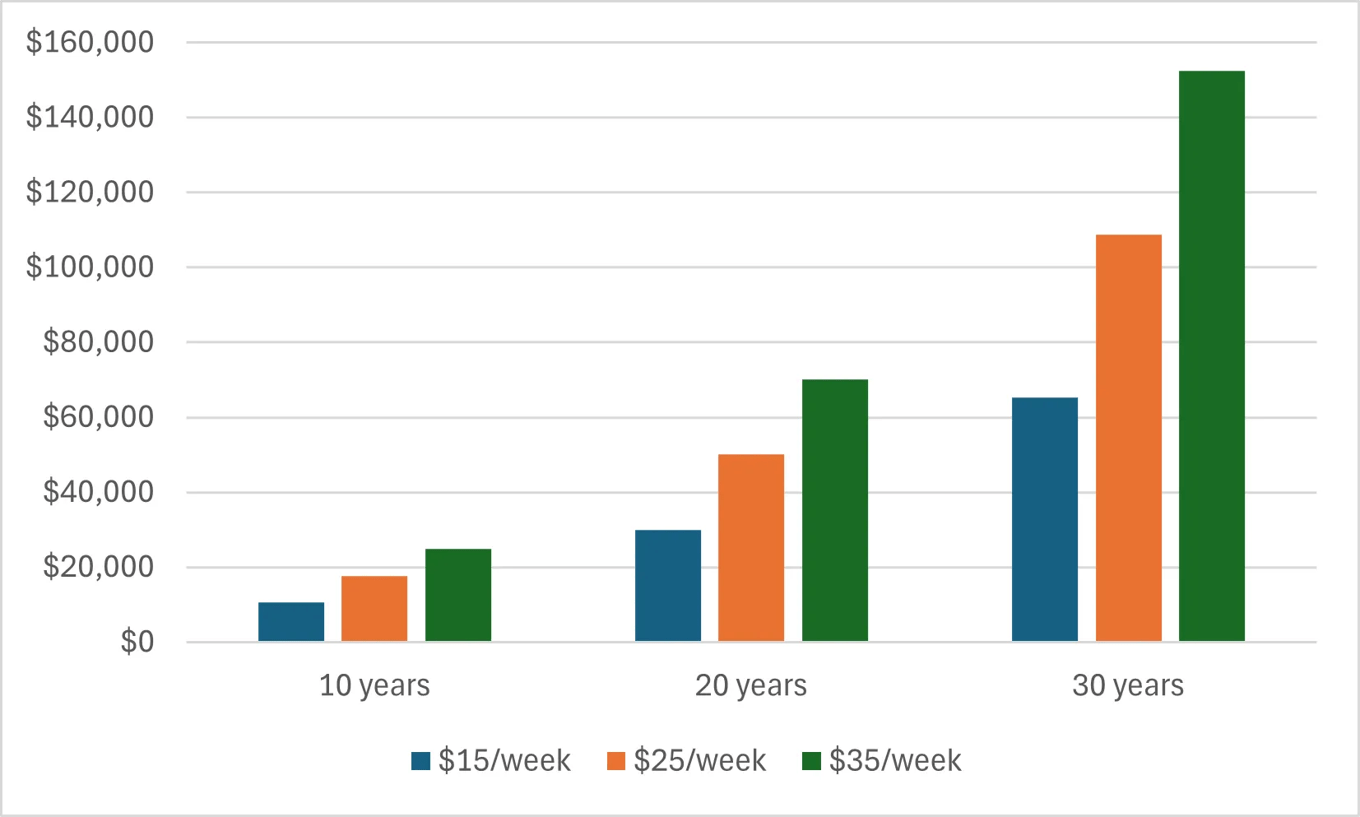
Assumes 6 percent hypothetical rate of return and contributions made at the beginning of each month. This illustration is hypothetical, is not guaranteed, and is not intended to reflect the performance of any specific investment. There is no assurance that increasing contributions will generate investment success. In addition, these figures do not reflect taxes or any fees or charges that may be assessed by the investments. The tax-deferred investment will be subject to taxes on withdrawal. Systematic retirement plan contributions do not ensure a profit nor guarantee against loss.
The difference comes simply from making consistent contributions over time.
Alex didn’t “find” $150,000. He redirected $35 a week — money that used to disappear — and let time do the heavy lifting. That refund didn’t change his life overnight, but it helped him start a steady habit that could support him for years to come.
Imagine doing the same
Now imagine if Alex also took advantage of his employer match. If his plan offers one, increasing his contribution enough to receive the full match could help him make the most of that benefit over time.
Using a refund or bonus as a moment to check your contribution level — and make a small adjustment — can be a simple way to build consistency without making dramatic changes.
Here’s how to put that idea into action:
- Check to see if your employer offers a match.
Are you receiving the full match? If not, consider increasing your contribution to capture it. - Increase your contribution by 1%.
Use part of your refund or bonus to help offset the change for the year. You may not feel a big difference in your paycheck, but over time, that increase can make a meaningful impact. - If offered, turn on auto-escalation.
Let future increases happen automatically. It can feel like giving yourself a small raise every year to put towards your future.
Maxing out?
Did you max out your contributions last year? Or plan on maxing them out this year? If so, you may still be able to continue saving beyond your employer-sponsored retirement plan by contributing to an Individual Retirement Account (IRA), depending on your situation. Voya offers IRA options that can complement your workplace plan. Consider speaking with a financial professional or tax advisor to understand what makes the most sense for you.
Ready to take the next step?
Log into your employer sponsored retirement plan. If a match is offered, check whether you’re receiving the full amount — and consider increasing your contribution.
Related Items



*Investor.gov
This information is provided for your education only through the Voya® family of companies. This information is not intended to provide legal, tax or investment advice. All investments are subject to risk. Please consult an independent tax, legal or financial professional for specific advice about your individual situation.
5467402_0126
CN5159122_0328