

Statutory Paid Leaves
Statutory paid leave laws continue to evolve as more states continue to propose, fund and launch their programs to support the needs of today’s workforce and to attract and retain top talent.
Voya is here to help you quickly identify changes by state and how they impact you and your employees.

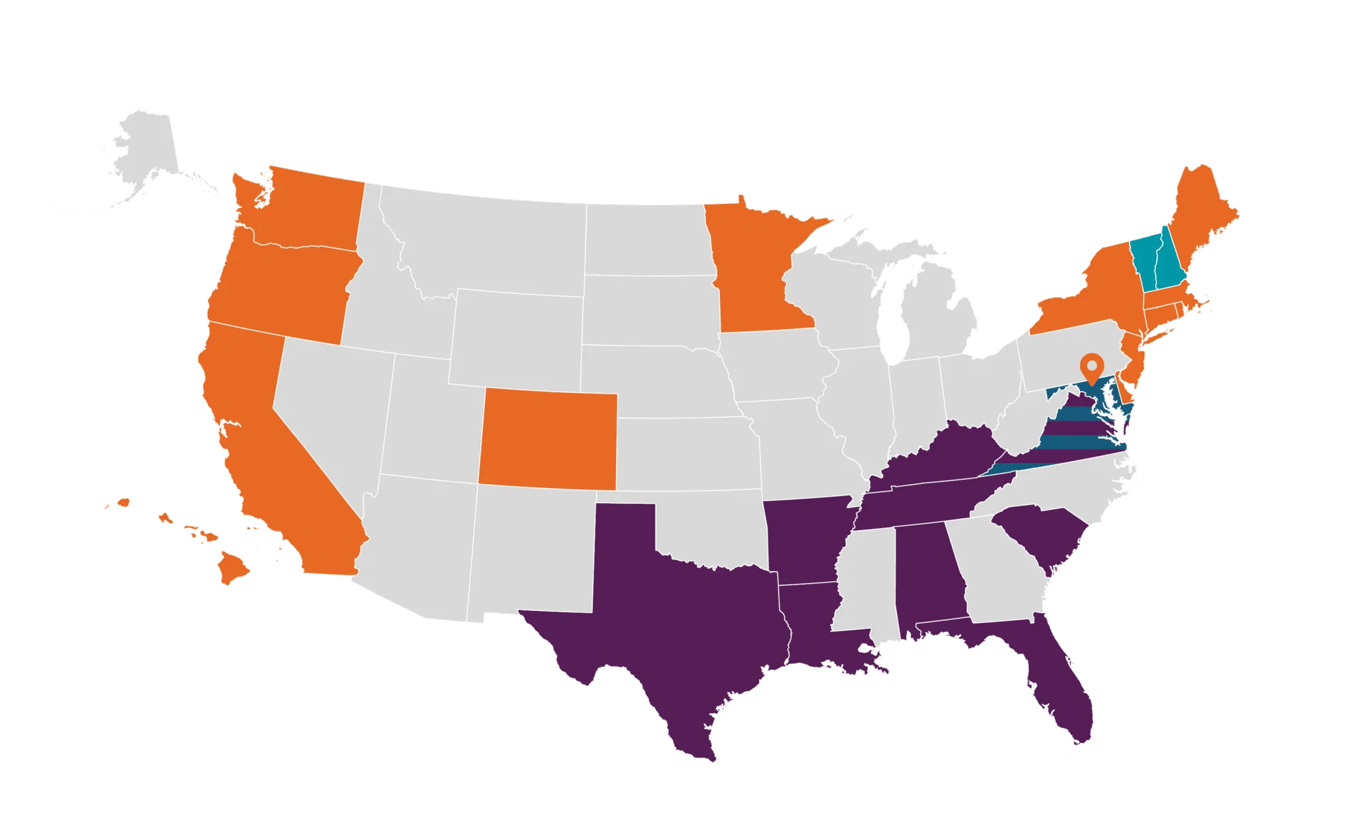
CA, CO, CT, D.C., DE, HI, NJ, NY, MA, ME, MN, OR, RI, WA
MD, VA
NH, VT
AR, AL, FL, KY, LA, SC, TN, TX, VA
This is not legal advice and is not intended to be, or replace, the advice of legal counsel. Indeed, we encourage you to discuss this information with your attorneys as necessary.
View the latest overview outlining leave legislation by state
State Disability Insurance (SDI)/Voluntary Disability Insurance (VDI) and Paid Family Leave (PFL) overview
Covered employer: Employers of one (1) or more employees with a quarterly payroll of $100 or more. Employers of domestic employees with a quarterly payroll of $750.
Employee eligibility requirements: Employee must have been paid $300 in wages from which SDI taxes were withheld during the base period. Individuals who are unemployed but actively looking for work when their need for disability or paid family leave begins, may be eligible for SDI/VDI or PFL if they meet certain criteria specified in the law.
Reason for leave:
- SDI: Eligible employees who are unable to do their usual work for at least eight (8) consecutive days due to any non-work-related illness, injury or pregnancy.
- PFL: Eligible employees can take leave for a family member’s qualifying military exigency; to care for a seriously ill child, spouse, parent, parent-in-law, grandparent, grandchild, sibling or domestic partner; or to bond with a new child entering an employee’s life by birth, adoption or foster care placement.
Benefit duration:
- SDI: Up to 52 weeks.
- PFL: 8 weeks in a 12-month period.
Benefit amount: Workers whose highest quarterly earnings (HQE) from the base period is equal to or less than 70% of the state average quarterly wage (SAQW), which is $23,257 for 2026, will receive 90% of their average wages. Workers whose HQE from the base period are greater than 70% of the SAQW, will receive the greater of 70% of their average wages or 63% of the state average weekly wage, which is $1,789 for 2026, up to the weekly max of $1,765 in 2026. Workers whose HQE are less than $722.50 will receive a weekly benefit of $50.
Private plan option: An employer can opt out of the state plan by providing a private plan that offers all the benefits of the state plan and exceeds the state plan benefit in at least one (1) provision. To be approved for a voluntary plan, the employer needs written approval from the majority of eligible employees and must post a security deposit.
Job protection: None. However, another leave that provides job protection, such as Federal FMLA or the California Family Rights Act (CFRA), may run concurrently with CA SDI or CA PFL.
What Voya offers:
- Administrative Services Only Private Plans (only offered matching state equivalent plans — no enhancements)
Resources: California State Disability Insurance
Family and Medical Leave Insurance Program (FAMLI) overview
Covered employer: All employers employing one (1) or more employees in the state of Colorado, or paid wages of $1,500 or more during any calendar quarter in the preceding calendar year, with a few exceptions.
Employee eligibility requirements: Any employee is eligible if they have worked for a covered employer and earned at least $2,500 in wages subject to premium during the person’s base period or alternate base period. Self-employed persons can elect coverage. An employee of a local government can also elect coverage where the local government has declined participation in the program.
Reason for leave:
- Bonding with the employee’s newborn or newly placed child within a year of the birth, adoption, or foster care placement;
- Caring for a family member with a serious health condition;
- Employee’s own serious health condition, including pregnancy;
- Qualifying military exigency;
- Safe leave; and
- Neonatal Intensive Care Unit (NICU) leave.
Benefit duration: A combined maximum of twelve (12) weeks of leave is available for the leave reasons listed above. An additional four (4) weeks of leave is available for serious health conditions related to pregnancy or childbirth complications. An additional twelve (12) weeks of paid leave is available for an employee whose infant is receiving inpatient care in the NICU. The leave maximums are available per “application year” which is measured as the 12-month period beginning on the first day of the calendar week in which an employee files an application for family and medical leave insurance benefits.
Benefit amount: Benefits are paid at 90% of the employee’s average weekly wage (AWW) up to 50% of the state’s average weekly wage (SAWW). Earnings greater than 50% of the SAWW will be paid at 50%. The maximum benefit is set to 90% of the SAWW. Effective July 1, 2026, the SAWW applicable to new and in-flight claims is $1,608.91 and the maximum weekly benefit amount for new and in-flight claims is $1,448.02.
Private plan option: Employers can apply for a private plan exemption if they have a plan that confers the same rights, protections, and benefits provided to the employees under the state program and does not cost employees more than the premium charged through the state program. Employers with self-insured plans must post a bond with the state. If the employer’s private plan is fully insured, the policy must be issued by an insurer approved by the State’s Insurance Commissioner.
Job protection: Yes, after 180 calendar days of employment with their current employer. The 180 days need not be consecutive as long as the gap in employment does not exceed 365 days. For continuous leaves, the 180 days must be met as of the start of the leave. For intermittent and reduced schedule leaves, the 180 days may be met during the approved leave period.
What Voya offers:
- Fully Insured options
- Administrative Services Only Private Plans (only offered matching state equivalent plans — no enhancements)
Resources: Colorado Family and Medical Leave Insurance Program
Paid Family and Medical Leave (PFML) overview
Covered employer: All employers employing one (1) or more employees in the state of Connecticut, with a few exceptions.
Employee eligibility requirements: Eligible employees must have earned at least $2,325 from one (1) or more employers during the highest-earning quarter of the base period and are either currently employed in CT or have been employed in the previous twelve (12) weeks. Employees need not reside in CT to be eligible. Terminated employees may continue to be eligible under their prior employer’s plan if they are not re-employed by a new covered employer within twelve (12) weeks of their termination.
Reason for leave:
- Employee’s own serious health condition, including pregnancy;
- Employee’s organ or bone marrow donation;
- Care for a family member with a serious health condition;
- Bonding with a new child within a year of the birth, adoption, or foster placement;
- Care for a family member injured in military duty;
- Qualifying military exigencies; and
- To address family violence or sexual assault situations.
Benefit duration: Eligible employees will be entitled to up to twelve (12) weeks of paid family and/or medical leave in any 12-month period. An additional two (2) weeks of paid leave is available for a serious health condition resulting in incapacitation that occurs during pregnancy for a combined maximum of fourteen (14) weeks. The two (2) additional weeks are only available during the pregnancy and are not available after the birth of the child. Family violence/sexual assault leave is limited to twelve (12) days in a 12-month period and is included as part of the 12-week total of PFML benefits.
Benefit amount: Eligible employees can receive up to 95% of their average weekly earnings, up to a weekly maximum of sixty (60) times the state minimum wage. Employees who earn more than forty (40) times the CT minimum wage will receive 60% of their average wages that exceed that amount (subject to the cap). Effective January 1, 2026, the maximum weekly benefit increased to $1,016.40 per week.
Private plan option: Employers can apply for a private plan exemption if they have a plan that confers the same rights, protections, and benefits as provided under the state program and does not cost employees more than the premium charged through the state program. Employers with self-insured plans must post a bond with the state. If the employer’s private plan is fully insured, the policy must be approved by the CT Insurance Department. A majority of the employees working in CT for the employer must vote in favor of a private plan.
Job protection: None. However, another leave that provides job protection, such as Federal FMLA or CT FMLA, may run concurrently with CT PFML.
What Voya offers:
- Fully Insured options
- Administrative Services Only Private Plans (only offered matching state equivalent plans - no enhancements)
Resources: Connecticut Paid Leave
Family and Medical Leave Insurance (FMLI) overview
Covered employer: Employers with twenty-five (25) or more employees who worked in DE during the previous twelve (12) months must provide all PFML coverage (i.e., parental, family caregiving which includes military exigency, and medical leave). Employers with 10-24 employees who work in the state are subject only to the parental leave provisions. Small businesses who do not meet those thresholds may opt into the program.
Employee eligibility requirements: Employees who work at least 1,250 hours over the 12-month period prior to the start of leave and who report for work primarily at a worksite within DE are eligible.
Reason for leave:
- Parental leave: Bonding with the employee’s newborn or newly placed child within a year of the birth, adoption or foster care placement;
- Family caregiving leave: Caring for a family member with a serious health condition and leave for a qualifying military exigency; and
- Medical leave: Employee’s own serious health condition, including pregnancy.
Benefit duration:
- Parental leave: Up to twelve (12) weeks of leave in an application year (i.e., the 12-month period measured forward);
- Up to six (6) weeks in any 24-month period, each, for care of a family member with a serious health condition, medical leave, or a qualifying military exigency
Benefit amount: Benefits are paid at 80% of the employee’s average weekly wage (AWW) during the four (4) quarters preceding submission of the leave application. The minimum weekly benefit is $100 and the maximum weekly benefit for 2026 and 2027 is $900.
Private plan option: Employers can apply for a private plan exemption for a plan that provides benefits at least equal to those required under the DE PFML law. Depending on the number of Delaware employees, employers may offer a private plan for parental leave only (between 10 and 24 employees) or offer a private plan for all leave reasons (i.e., parental, family caregiving and medical). Private plans may be self-insured or insured through a carrier and must start at the beginning of a quarter.
Job protection: Yes.
What Voya offers:
- Fully Insured options
- Administrative Services Only Private Plans (only offered matching state equivalent plans — no enhancements)
Resources: Delaware Paid Leave
Paid Family Leave (PFL) overview
Covered employer: All employers with one (1) or more employees in Washington, D.C., that also pay unemployment insurance taxes for their employees.
Employee eligibility requirements: Employees are eligible if they work for a covered employer and spend more than 50% of their work time for that employer in the District; or whose employment for the covered employer is based in the District and who regularly spends a substantial amount of their work time for that covered employer in the District and not more than 50% of their work in another jurisdiction.
Reason for leave:
- Birth or placement of a child into the household;
- Care for a family member with a serious health condition;
- Employee’s own serious health condition; and
- Prenatal care.
Benefit duration:
Eligible employees are entitled to be paid for up to the following:
- Bonding/parental leave: 12 weeks;
- Family leave to care for a family member with a serious health condition: 12 weeks;
- Medical leave for employee’s own serious health condition: 12 weeks; and
- Prenatal leave: 2 weeks
Combined Leave Benefits: An employee may not take more than twelve (12) weeks total of PFL in a 52-week period, unless the individual takes both prenatal leave (up to two weeks) and parental bonding leave (up to twelve weeks) for a total of fourteen (14) weeks of combined leave.
Benefit amount: Weekly benefit amounts are determined on a sliding scale based on the employee’s income, up to 90% of weekly pay with a cap of $1,190 per week for 2026.
Private plan option: There is no private option for the program. The PFL program is administered by the Office of Paid Family Leave (OPFL) within the Department of Employment Services (DOES). Eligible employees apply for leave benefits, receive their eligibility determinations, and benefit awards from OPFL.
NOTE: D.C. does not permit fully insured, short-term disability policies to take an offset for DC PFL benefits.
Job protection: None. However, another leave that provides job protection, such as Federal FMLA or DC FMLA, may run concurrently with DC PFL.
Resources: DC Paid Family Leave
Temporary Disability Insurance (TDI) overview
Covered employer: Employers who have one (1) or more employees and employers of domestic employees with a quarterly payroll of $225 or more.
Employee eligibility requirements: An employee must have fourteen (14) weeks of covered employment during which time the employee was paid for twenty (20) hours or more and earned at least $400 in the first fifty-two (52) weeks prior to the day of disability. The fourteen (14) weeks need not be consecutive nor with only one (1) employer, but the employee must be currently employed. If the employee was separated from their job at the time the time the disability occurred, they are considered currently employed if the disability occurred within two (2) weeks of their last day of work.
Reason for leave: Employees who are ill and/or injured (non-work related) and unable to work for at least eight (8) consecutive days.
Benefit duration: The maximum benefit available is 26 weeks per benefit year.
Benefit amount: Weekly benefits are 58% of the employee’s average weekly wages, up to a maximum set annually by the state, which is $871 per week for 2026.
Private plan option: Hawaii does not administer a state plan but requires that employers provide a minimum Temporary Disability Insurance (TDI) Plan, which may be insured, self-insured, or an approved collective bargaining agreement, that provides sick leave and disability benefits.
Job protection: None. However, another leave that provides job protection, such as Federal FMLA or HI Family Leave Law (HFLL), may run concurrently with HI TDI.
What Voya offers:
- Fully Insured options
Resources: Hawaii Temporary Disability
Paid Family and Medical Leave (PFML) overview
Covered employer: All employers who employ at least one (1) employee in Maine.
Employee eligibility requirements: Employees are eligible if they have earned at least six (6) times the state average weekly wage (SAWW) during the employee’s base period. Employees must be employed on the date of application in advance of leave or employed as of date leave began if applying retroactively.
Reason for leave:
Eligible employees are entitled to paid leave for:
- Employee’s own serious health condition, including pregnancy;
- Care for a family member with a serious health condition;
- Bonding with a new child within a year of the birth, adoption or foster placement;
- Military caregiver leave;
- Leave due to the death of an employee’s spouse, domestic partner, parent or child if they are a service member and died while on active duty;
- Safe leave (when employee or employee’s family member has experienced violence, assault, sexual assault, stalking or other abusive acts);
- Organ donation; and
- Qualifying military exigencies.
Benefit duration: Beginning May 1, 2026, eligible employees may take up to twelve (12) weeks of PFML in a benefit year.
Benefit amount: Benefit amounts vary depending on the employee’s average weekly wage (AWW). The portion of the employee’s AWW that is equal to or less than 50% of the SAWW rounded up is replaced at 90% and rounded up, while the portion of the AWW that is more than 50% of the SAWW rounded up is replaced at 66% rounded up. The maximum weekly benefit is the SAWW, which is $1,249.12 effective July 1, 2026.
Private plan option: Maine will permit the use of a private employer plan that must be substantially equivalent to the benefits offered under the state’s PFML program. A private plan may be fully insured or self-insured and must be approved by the Maine Department of Labor.
Job protection: Yes, after 120 consecutive days of employment with the current employer.
What Voya offers:
- Fully Insured options
- Administrative Services Only Private Plans (only offered matching state equivalent plans — no enhancements)
Resources: Maine Paid Family and Medical Leave
Paid Family and Medical Leave (PFML) overview
Covered employer: All employers who employ at least one (1) employee in Maryland.
Employee eligibility requirements: Employees are eligible if they work at least 680 hours in Maryland over the four (4) most recently completed calendar quarters prior to the start of leave.
Reason for leave:
Eligible employees are entitled to paid leave for:
- Employee’s own serious health condition, including pregnancy;
- Care for a family member with a serious health condition;
- Bonding with a new child within a year of the birth, adoption, foster placement, or placement for kinship care;
- Care for a covered service member with a serious health condition resulting from military service who is the employee’s next of kin; and
- Qualifying military exigencies arising out of the deployment of a service member who is a covered family member of the employee.
Benefit duration:
Beginning January 3, 2028, eligible employees may take up to:
- 12 weeks of PFML in an Application Year; and
- If the employee experiences both their own serious health condition and welcomes a child in the same year, they could be eligible for up to 12 weeks per event for a total of up to 24 weeks in an application year. While the two events could be related, they do not have to be.
Benefit amount: If the employee’s average weekly wage (AWW) is 65% or less of the state average weekly wage (SAWW), the weekly benefit is 90% of the employee’s AWW. If the employee’s AWW is greater than 65% of the SAWW, the weekly benefit is the sum of 90% of the employee’s AWW up to 65% of the SAWW and 50% of the employee’s AWW that is greater than 65% of the SAWW. The minimum weekly benefit amount is $50 and the maximum benefit amount for 2028 is $1,000.
Private plan option: Maryland will permit the use of a private employer plan consisting of employer-provided benefits, insurance, or a combination of both. The private plan must be offered to all eligible employees and meet or exceed the rights and benefits offered under the state’s PFML program. A private plan also must be approved by the Maryland Department of Labor.
Job protection: Yes, with a few exceptions.
What Voya offers:
- Coming Soon
Resources: Maryland Paid Family and Medical Leave
Paid Family and Medical Leave (PFML) overview
Covered employer: All Massachusetts private sector employers with one (1) or more employees in the Commonwealth of Massachusetts.
Employee eligibility requirements: Employees must meet a financial eligibility requirement, earning at least $6,300 during the last four (4) completed calendar quarters, and earning at least thirty (30) times their weekly PFML benefits. Terminated employees may continue to be eligible under their prior employer’s plan if they are not re-employed by a new covered employer within twenty-six (26) weeks of their termination.
Reason for leave:
- Employee’s own serious medical condition, including pregnancy;
- Care for a family member with a serious health condition;
- Bonding with a new child within a year of the birth, adoption or foster placement;
- Care for a covered service member; and
- Qualifying military exigency.
Benefit duration:
Eligible employees may take up to:
- Twenty (20) weeks of paid medical leave for employee’s own serious health condition;
- Twelve (12) weeks of paid family, bonding and military exigency leave; and
- Twenty-six (26) weeks of paid leave to care for a covered service member.
An employee may not take more than twenty-six (26) weeks of combined leave in a benefit year. The “benefit year” begins the Sunday of the week in which leave is first taken and lasts for fifty-two (52) consecutive weeks.
Benefit amount: Benefit amounts vary depending on the employee’s average weekly wage (AWW). The portion of the individual’s AWW that is equal to or less than 50% of the state average weekly wage (SAWW) is replaced at 80% while the portion of the AWW that is more than 50% of the SAWW is replaced at 50% and subject to the maximum cap of $1,230.39 for 2026.
Private plan option: Employers can apply for a private plan exemption if they have a plan that confers at least the same rights, protections and benefits as provided under the state program and does not cost employees more than the premium charged through the state program. Employers with self-insured plans must post a surety bond with the state. Employers may also purchase private plan coverage through an approved insurance carrier.
Job protection:Yes.
What Voya offers:
- Fully Insured options
- Administrative Services Only Private Plans (only offered matching state equivalent plans — no enhancements)
Resources: Massachusetts Paid Family and Medical Leave
Paid Family and Medical Leave (PFML) overview
Covered employer: All Minnesota employers with one (1) or more employees in the state.
Employee eligibility requirements: Employees must meet a financial eligibility requirement, earning at least 5.3% of the state’s average annual wage during the employee’s base period (currently, that amounts to earning at least $3,500 per year).
Reason for leave:
- Employee’s own serious medical condition, including pregnancy;
- Care for a family member with a serious health condition;
- Bonding with a new child within a year of the birth, adoption or foster placement;
- Qualifying military exigency; and
- Safe leave (due to domestic abuse, sexual assault or stalking of the employee or the employee's family member).
Benefit duration: Eligible employees may take up to twelve (12) weeks of medical leave for their own serious health condition and up to twelve (12) weeks of family leave. However, the combined maximum for all leave reasons is twenty (20) weeks of leave in a benefit year.
Benefit amount: Benefit amounts vary depending on the employee’s average weekly wage (AWW). The portion of the AWW that does not exceed 50% of the state average weekly wage (SAWW) is replaced at 90%; the portion of the AWW that exceeds 50% of the SAWW but not 100% of the SAWW is replaced at 66%; and the portion of the AWW that exceeds 100% of the SAWW is replaced at 55% subject to the maximum benefit amount, which is the SAWW and is currently $1,423 for 2026.
Private plan option: Employers can apply for a private plan exemption if they have a plan that confers at least the same rights, protections, and benefits as provided under the state program and does not cost employees more than the premium charged through the state program. The Minnesota Department of Employment and Economic Development must approve all private plans, which may be self-insured or fully insured through a carrier. Coverage under a private plan will continue while an employee remains employed by the employer. An employee is not covered by a private plan if a leave occurs after the employment relationship with the private plan employer ends. An employee no longer covered by an approved private plan is immediately entitled to benefits under the state plan if otherwise eligible.
Job protection: Yes, after ninety (90) days of employment with their current employer.
What Voya offers:
- Fully Insured options
- Administrative Services Only Private Plans (only offered matching state equivalent plans — no enhancements)
Resources: Minnesota Paid Leave
Paid Family and Medical Leave (PFML) overview
Covered employer: Mandatory for state employees (i.e., the State of New Hampshire as employer) but voluntary for private employers and all public non-state employers. A tax credit of 50% of premiums is provided to employers who opt-in to the program and purchase a NH PFML plan from MetLife.
Employee eligibility requirements: Employees must be designated as working for a NH employer and report wages to NH for unemployment purposes to be eligible for NH PFML coverage. If a private employer does not have a NH PFML plan, individual workers may purchase PFML benefits through a purchasing pool, which includes a seven-month waiting period before benefits may begin.
Reason for leave:
Paid leave may be used for:
- Employee’s own serious health condition (when disability coverage does not apply);
- The birth or placement of a child into the household;
- To care for a family member with a serious health condition;
- For a qualifying military exigency; or
- To care for a service member with a serious injury or illness.
Benefit duration: Private employers may choose a plan that provides up to six (6) weeks per year, or twelve (12) weeks per year.
Benefit amount: Eligible employees receive 60% of their average weekly wage, with the wages capped at the amount of the Social Security taxable wage maximum, which is $184,500 for 2026.
Private plan option: Private employers who opt-in to the state program may contract directly with MetLife and get a tax credit equal to 50% of the NH PFML insurance premium. Employers also may choose to provide other PFML insurance approved by the New Hampshire Department of Insurance, or provide PFML benefits through an equivalent self-insured benefit plan.
Job protection: None. However, another leave that provides job protection, such as Federal FMLA, may run concurrently with NH PFML.
Resources: New Hampshire Paid Family and Medical Leave
Temporary Disability Insurance (TDI) and Family Leave Insurance (FLI) overview
Covered employer: All private sector employers subject to the New Jersey Unemployment Compensation law.
Employee eligibility requirements: Employees must work at least twenty (20) calendar weeks earning at least $310 weekly, for 2026, or have earned a combined total of $15,500 for 2026 in the base period (the first four of the last five completed calendar quarters preceding the first day of leave/disability), alternate base period 1 (the last four completed calendar quarters preceding the first day of leave/disability), or the alternate base period 2 (the last three completed calendar quarters immediately preceding the first day of leave/disability and including the weeks in the current calendar quarter up to the first day of leave/disability).
Reason for leave:
- TDI: Eligible employees are entitled to paid leave when they are unable to work due to a non-work-related illness, injury or other disability, including pregnancy.
- FLI: Eligible employees are entitled to family leave to care for a newly born or newly placed child within twelve months of the date of birth or placement, and to care for family member with a serious health condition. Family leave can also be used to care for eligible family members who are victims of domestic and sexual violence.
Benefit duration:
- TDI: Twenty-six (26) weeks or the period necessary for benefits to equal 1/3 of total wages in the base year, whichever is the lesser.
- FLI: Twelve (12) consecutive weeks or fifty-six (56) intermittent days during a 12-month period beginning with the first date of the claim.
Benefit amount: TDI and FLI: Up to 85% of employee’s average weekly wage. The maximum weekly benefit amount is $1,119 for 2026.
Private plan option: Employers can choose the state plan or an insured or self-insured plan, which must at least equal the provisions of the state plan.
Job protection: Starting July 17, 2026, New Jersey workers have expanded job protection when they need time off work to care for themselves and loved ones. Employees receiving TDI/FLI benefits through the State or an approved private plan are entitled to job protection during leave if the leave is not otherwise covered by the New Jersey Family Leave Act. Upon return, the employee must be reinstated to the same or an equivalent position with the same pay, benefits, seniority, and other terms of employment. There are no minimum employer size or employee tenure requirements; eligibility for TDI/FLI benefits is based on the employee's recent earnings.
What Voya offers:
- Fully Insured options offered (TDI only)
- Administrative Services Only Private Plans (only offered matching state equivalent plans — no enhancements) (FLI only)
Resources: New Jersey Temporary Disability and Family Leave Insurance
Disability Benefits Law (DBL) and Paid Family Leave (PFL) overview
Covered employer: Employers who have one (1) or more employees in New York for at least thirty (30) days in any calendar year.
Employee eligibility requirements:
- DBL: Employees who work four (4) consecutive weeks of covered employment are eligible for benefits. Terminated employees are eligible for DBL benefits for thirty (30) days after their termination.
- PFL: Employee must have been employed by a covered employer for twenty-six (26) or more consecutive weeks (or 175 days of employment for part-time employees).
Reason for leave:
- DBL: Employee who cannot work due to an illness that was not caused by their job or a disability from a non-occupational injury.
- PFL: Paid family leave to bond with a new child during the first year of birth, adoption, or placement in foster care; to care for family member with serious health condition; or for a qualifying exigency arising out of a spouse, domestic partner, child, or parent being on active duty (or having been notified of an impending call or order to active duty).
Benefit duration:
Eligible employees are entitled to:
- DBL: Twenty-six (26) weeks within 52-week period.
- PFL: Twelve (12) weeks.
The maximum length for DBL & PFL benefits combined cannot exceed twenty-six (26) weeks in a consecutive 52-week period.
Benefit amount:
- DBL: 50% of an employee’s average weekly wage (AWW) based on the previous eight (8) weeks of earnings. Eligible employees will receive at least $20 per week and no more than $170 per week.
- PFL: 67% of an employee’s AWW not to exceed 67% of the state average weekly wage, up to the maximum of $1,228.53 per week in 2026.
Private plan option:
- DBL: An employer can self-insure, insure the benefits through the NY State Insurance Fund (NYSIF), or insure the benefits through a private insurance carrier.
- PFL: An employer can purchase PFL coverage from a private insurer or through NYSIF. An employer can self-insure PFL if they are currently self-insured for DBL.
Job protection:
- NY DBL: None. However, another leave that provides job protection, such as Federal FMLA or certain state laws, may run concurrently with NY DBL.
- NY PFL: Yes.
What Voya offers:
- Fully Insured options
Resources: New York State Paid Family Leave
Paid Family and Medical Leave (PFML) overview
Covered employer: All private sector employers with one (1) or more employees in the state of Oregon.
Employee eligibility requirements: During the base year or alternative base year, eligible employee must have earned at least $1,000 in wages and paid into the Paid Family and Medical Leave Insurance Fund.
Reason for leave:
- Employee’s own serious health condition, including pregnancy;
- Care for a family member with a serious health condition;
- Bonding with a new child within a year of the birth, adoption or foster placement;
- §Safe leave for the employee or the employee’s minor child who is a victim of domestic violence, harassment, sexual assault, bias crimes or stalking; and
- §Pre-placement leave for employees planning to adopt or foster a child.
Benefit duration: Eligible employees in Oregon are entitled to twelve (12) weeks of paid leave. An employee may take up to an additional two (2) weeks of leave for limitations for a serious health condition related to pregnancy, childbirth, or related medical conditions, including lactation, for a total of fourteen (14) weeks of paid leave. The two (2) additional weeks cannot be used more than once per pregnancy, regardless of whether the individual has started a new benefit year.
Benefit amount: Employees who earn 65% or less of the state average weekly wage (SAWW) will be paid 100% of their average weekly wage (AWW) subject to the minimum benefit amount, which is $70.51 effective June 28, 2026. The prior minimum of $68.19 applies to claims prior to June 28, 2026. Employees who earn greater than 65% of the SAWW will be paid 65% of the SAWW plus 50% of the employee’s AWW that exceeds 65% of the SAWW, subject to the maximum weekly benefit of $1,692.16 for new claims beginning on or after July 6, 2026.
Private plan option: Employers may apply to have an approved equivalent plan to replace the State Plan. The plan must be equivalent to the state program and may be either fully insured or self-insured.
Job Protection: Yes, after ninety (90) consecutive calendar days of employment with their current employer (with a few exceptions for small employers). The ninety (90) days must be met prior to the start of the leave.
What Voya offers:
- Fully Insured options
- Administrative Services Only Private Plans (only offered matching state equivalent plans — no enhancements)
Resources: Oregon Paid Leave
Temporary Disability Insurance (TDI) and Temporary Caregiver Insurance (TCI) overview
Covered employer: All private sector employers with one (1) or more employees in the state of Rhode Island.
Employee eligibility requirements: Employee must work for a Rhode Island covered employer and have a medically certified disability. Employees must also have been paid wages in Rhode Island of at least $19,200 in the base period and paid into the TDI/TCI fund. Alternately, employees qualify if they earned at least $3,200 in a quarter of their base period, their total base period taxable wages were at least 150% of their highest quarter of earnings, and their taxable wages during their base period are $6,400 or more.
Reason for leave:
- TDI: Eligible employees are entitled to TDI when they have been unable to work for at least seven (7) days due to a non-job-related illness or injury.
- TCI: Eligible employees are entitled to family leave to bond with a newly born or newly placed child, or to care for family member with serious health condition.
Benefit duration:
- TDI: Thirty (30) weeks in any benefit year
- TCI: Up to eight (8) weeks in a benefit year
The combined maximum benefit for both TDI and TCI is thirty (30) weeks in a benefit year.
Benefit amount: The average weekly benefit rate is 4.62% of wages paid during the highest quarter of the individual’s base period. The minimum weekly benefit is $148, and the maximum is $1,103 per week. The benefit increases if the employee has dependents. The maximum dependents allowance is the greater of $20 per dependent or 7% of the weekly benefit rate (up to five dependents).
Private plan option: There is no Private Plan option in Rhode Island. The Rhode Island Department of Labor and Training administers TDI and TCI. Eligible employees will apply for benefits, receive their eligibility determinations, and benefit awards from the state of Rhode Island.
Job protection: None for TDI. However, another leave that provides job protection, such as Federal FMLA, may run concurrently with RI TDI.
Employers are required to offer employees a comparable position when they return from TCI leave.
Resources: State of Rhode Island Temporary Disability and Caregiver Insurance
Family and Medical Leave Insurance (FMLI) overview
Covered employer: Voluntary PFML program is available to most employers in the state.
Employee eligibility requirements: No Employee eligibility requirements have been published.
Reason for Leave: Paid leave may be used for:
- Employee’s own serious health condition;
- The birth, adoption or placement from foster care of a child within one year of birth/placement;
- To care for a family member with a serious health condition;
- For a qualifying military exigency; or
- To care for a service member with a serious injury or illness.
Benefit duration: Up to six (6) weeks in a 12-month period.
Benefit amount: Up to 60% of the employee’s average weekly wages, capped at the Social Security taxable wage maximum.
Private Plan option: Private employers who opt-in to the voluntary program may contract directly with The Hartford. Because the VT FMLI program is voluntary for private employers, employers also may choose to provide alternative benefits on their own.
Job Protection: None. However, another leave that provides job protection, such as Federal FMLA or VT Parental and Family Leave law, may run concurrently with VT PFML.
Resources: Vermont Family & Medical Leave
Paid Family and Medical Leave (PFML) — Coming in 2028
Covered Employer: Public and private employers that paid wages of $1,500 or more in any calendar quarter in the current or preceding calendar year or employed at least one (1) employee for some portion of a day in each of 20 weeks in the current or preceding calendar year. The Commonwealth of Virginia is not a covered employer.
Employee Eligibility Requirements: An employee is eligible if the employee earned sufficient wages in their base period to qualify for unemployment insurance.
Reasons for Leave:
- Employee’s own serious health condition
- Birth, adoption or placement from foster care of a child within one year of birth/placement
- Care for a family member with a serious health condition
- Qualifying military exigency
- Care for a service member who is the employee’s next of kin or other family member with a serious injury or illness
- For purposes of seeking safety services for employee or employee’s family member (Safe Leave)
Benefit Duration: Eligible employees are entitled to twelve (12) weeks in a benefit year of paid leave for family care, bonding, own serious health condition and exigency. Eligible employees are entitled to up to four (4) weeks in a benefit year for Safe Leave. The combined maximum for a benefit year is twelve (12) weeks.
Benefit Amount: Eligible employee’s benefits will be either 80% of the employee’s average weekly wage (AWW) during the base period, or 80% of the employee’s average weekly wage in the quarters in which the employee worked if less than five (5) quarters, subject to the applicable maximum benefit. The maximum benefit is 100% of the state average weekly wage. The minimum weekly benefit will be the least of the employee’s AWW or $100 per week.
Private Plan Option: Employers may provide a private plan after obtaining approval from the Virginia Employment Commission. A private plan must confer all of the same rights, protections and benefits as the state plan and cannot cost the employees more than they would remit in the state plan. For self-insured private plans, the employer must demonstrate financial capacity to meet claim obligations. An employer with an approved private plan is not required to remit premiums to the state program. Private plans must be renewed every two years.
Job Protection: Employees are eligible for job protection if they have been employed by the employer at least 120 days prior to the leave.
What Voya offers:
- Coming Soon
Resources: vec.virgina.gov
Paid Family and Medical Leave (PFML) overview
Covered employer: All public and private employers with one (1) or more employees in the state of Washington.
Employee eligibility requirements: Employees must have worked for at least 820 hours, during the qualifying period for one or more employers in Washington. If an employee was covered under a voluntary plan by their previous employer, they are immediately eligible for their new employer’s voluntary plan.
Reason for Leave:
- Employee’s own serious health condition, including pregnancy;
- Bonding with new child within the first twelve months after birth, adoption or placement in foster care;
- Care for a family member with a serious health condition;
- Qualifying exigency arising out of family member being on active duty (or having been notified of an impending call or order to active duty); and
- Bereavement for the loss of a newborn or newly adopted/placed child (within a year of the child’s death).
Benefit duration: Eligible employees are entitled to use up to twelve (12) weeks of paid leave for their own medical condition or for family care. An employee may take an additional two (2) weeks of medical leave if needed because of incapacity due to pregnancy-related conditions, for a total of fourteen (14) weeks of medical leave. Child bereavement leave is up to seven (7) calendar days. An employee cannot take more than sixteen (16) weeks of combined medical and family leave per year or more than eighteen (18) weeks if the additional two (2) weeks of leave is needed due to pregnancy-related incapacitation.
Benefit amount: If the employee’s average weekly wage (AWW) is equal to or less than 50% of the state average weekly wage (SAWW), the weekly benefit amount is 90% of the AWW rounded down to the next whole dollar. If the employee’s AWW is greater than 50% of the SAWW, the weekly benefit amount is the sum of 90% of half of the SAWW and 50% of the difference between the AWW and half of the SAWW, rounded down to the next whole dollar. For 2026, the SAWW is $1,830 and the maximum weekly benefit is $1,647.
Private Plan option: Employers can apply for a private plan exemption for either paid family leave, paid medical leave, or both if their plan provides benefits that are greater than or equal to the benefits provided by the state PFML program. The state must approve all voluntary plans. A plan’s effective date will be the first day of the quarter following state approval.
Job Protection: Yes, for employer’s with at least twenty-five (25) employees, job protection is required for any employee who has worked for at least 180 calendar days as of the start of leave. Beginning 1/1/2027, the employer threshold drops to employers with at least fifteen (15) employees. For employers with 8 or more employees, the restoration obligation begins 1/1/2028.
What Voya offers:
- Administrative Services Only Private Plans (only offered matching state equivalent plans — no enhancements)
Resources: Washington Paid Family and Medical Leave
View the latest full-length overview outlining requirements by state
Voya Leave Management services provided in part by Disability Reinsurance Management Services.
Insurance is issued by ReliaStar Life Insurance Company (Minneapolis, MN) and ReliaStar Life Insurance Company of New York (New York, NY). Within the State of New York, only ReliaStar Life Insurance Company of New York is admitted, and its products issued. Both are members of the Voya® family of companies. Voya Employee Benefits is a division of both companies. Product availability and specific provisions may vary by state.