

You are using an unsupported browser that may limit access to certain website applications. If you continue, you may not be able to access certain pages or process requests. Please use one of our recommended browsers to experience the website properly.
Your savings, your legacy: Giving smarter with QCDs
September 29, 2026
You’ve spent a lifetime building your savings. Now imagine directing some of those savings from your IRA toward the causes that matter most to you — feeding your community, supporting research or backing the local nonprofit that’s always been close to your heart. That’s the feeling a Qualified Charitable Distribution, or QCD, is designed to create: the satisfaction of knowing your money is doing real good in the world, while still working in your favor come tax time.
If you’re 70½ or older and charitably inclined, a QCD lets you give directly from your IRA to a qualified charity up to IRS limits — one of the most meaningful, tax-efficient moves you can make with your retirement savings.
Here’s how it works, why it matters and how to get started before year-end.
What Is a QCD?
A QCD enables you to give amounts up to that year's QCD limit from your IRA straight to an eligible charity. You cannot take the money out of the IRA yourself and then donate it to that charity. Instead, to meet the IRS rules for a QCD, you direct the IRA trustee/custodian holding your IRA to send the money directly to the eligible charity. Under the QCD rules, the charitable contribution may be excluded from a taxpayer's income. For more information on how to calculate this deduction, please visit the IRS website.
That’s the big difference — and it can save you a lot.
The Numbers at a Glance
If you’re at least 70½ years old, you can give up to $111,000 per year (in 2026 and subject to annual IRS cost of living adjustments) from your IRA directly to charity. If you’re married and file your federal individual income tax return jointly, your spouse may also claim a QCD from their own IRA — up to $222,000 for your household. 1
There’s no minimum amount of a QCD, so you may start small. Even a small QCD may make a real difference on your taxes.
Why QCDs Are So Powerful
Once you become subject to the IRS Required Minimum Distribution (RMD) rules, you must take a RMD from your traditional IRA accounts every year. That is, the IRS requires that you begin to withdraw amounts from your IRA, which then are subject to federal income taxes. RMDs may push you into a higher federal income tax bracket, potentially making make more of your Social Security taxable and even raise your Medicare premiums.
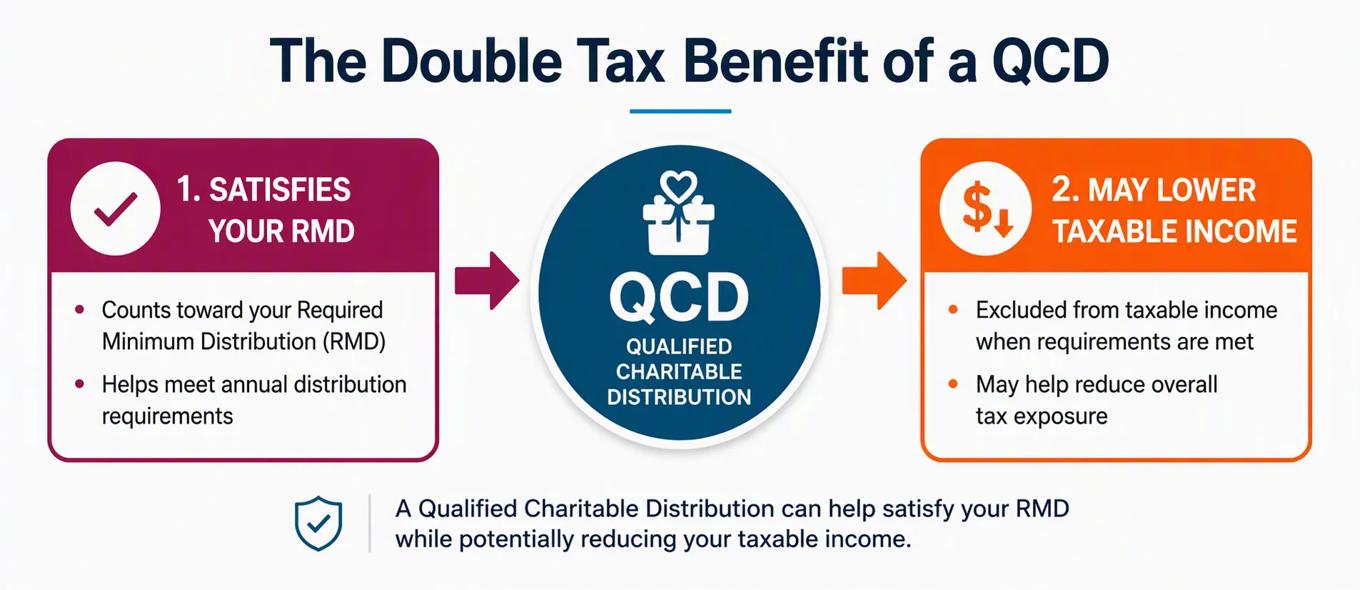
A QCD may be helpful if you are taking RMDs. Since the withdrawal is paid straight to an eligible charity, the QCD is excluded from your taxable income, but the amount of the QCD counts towards satisying your RMD for that tax year. So, you meet your RMD requirement without adding to your taxable income.
Why does that matter? Because your taxable income affects a lot of things — how much of your Social Security is taxed, what you pay for Medicare and whether you qualify for certain tax breaks. Keeping that number lower can quietly save you money, year after year.
Who Can Use a QCD?
You can use a QCD if you’re 70½ or older, even if you are not yet subject to RMD. This give you a head start to shrink your IRA balance before you’re even required to take money out.
A few rules to know:
- The withdrawal must be paid from the IRA trustee/custodian holding the IRA directly from your IRA to a qualified charity — you cannot receive the withdrawal first.
- You can’t use a QCD for a donor-advised fund or private foundation (with one small exception).
- If you’ve made deductible contributions to your traditional IRA when in tax years when you were 70½ or older, this will reduce the amount that you can claim as a QCD. For more information, check with your tax advisor if that applies to you.
A Simple Example
Let’s say your RMD for the year is $20,000, and you usually give $5,000 to charity. If you take the full $20,000 as income, all of it is taxable. But if you send $5,000 as a QCD, only $15,000 counts as taxable income — and you’ve still met your full RMD. The $5,000 goes to charity, and your taxable income is lower.
It’s a win for your favorite cause and potential lower taxes for you.
Don’t Wait Until December
QCDs must be fully processed and paid to the eligible charity by December 31 to count for the current tax year. Since the transaction is time sensitive, you may want to start planning well in advance of year end.
Consider reaching out to your financial professional or IRA company. Confirm your RMD amount, identify the eligible charities you want to support and get the transaction moving while there’s still plenty of time.
Related Items



1Publication 590-B (2025), https://www.irs.gov/publications/p590b
This material is provided by Voya for general and educational purposes only; it is not intended to provide legal, tax or investment advice. All investments are subject to risk. Please consult an independent tax, legal or financial professional for specific advice about your individual situation.
CN5925031_0928